

Traffic, reach, and impressions have become hot topics recently. It’s about time.
Businesses understand that more visibility would naturally nudge more growth. But is that absolutely true? Well, it is, but there is a major catch.
Only a well-structured funnel can save potential customers for a brand. In between curiosity and commitment, it ensures that nothing is lost in disconnected pages, unclear messaging, and friction-filled experiences.
Premium brands are very particular about what happens after the clicks. They realise that it is not the clicks but conversion that actually pays the bills. Digital marketing strategy is designed in a way that it focuses on people without ignoring post-click performance.
There is a gap between traffic and revenue that is becoming impossible to ignore in today’s market trends. This is because more businesses pour money into advertisements and content with SEO. The real advantage no longer lies in who attracts attention, but in who knows how to guide it.
It is essential for us to understand funnels on a deeper level, as they play a very important role in the equation. Conversations are slowly shifting toward funnels, and brands need to refrain from building pipelines that look good on dashboards but fail where it actually matters: turning interest into action.
Funnels as a Dynamic, Three-Layer System
Most brands have the pieces in place, but without a connected system, those efforts fail to drive real conversions.
A landing page or an email campaign is what all brands possess. They are well aware of the marketing trends and would also have their own kind of funnel strategy. This is enough to give an illusion that things are well-managed.
What is a funnel, though? It is the roadmap of how a customer starts from their first interaction and reaches the final action. It includes mapping the strategies of converting mere visitors into trusted customers and eventually into solid revenue.
A funnel maps exactly how a user comes in, when they pause, and what makes them leave. But the problem is that it is not what fuels the journey for you.
Now this is where most brands make the mistake.
Funnels are made as static assets. They imagine this to be a straight path. Each stage is analysed separately. The important point that they miss out is that every stage interconnects to make this system which is highly dynamic.
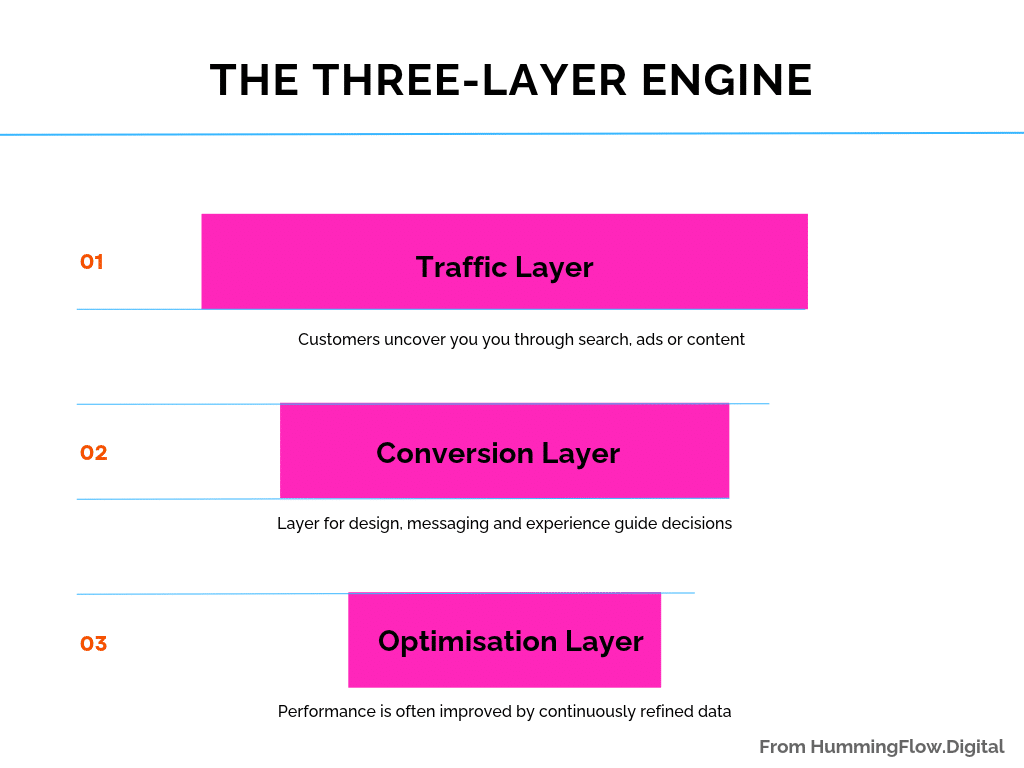
It is important to understand that real ROI occurs as the funnel operates as a three-layer system:
- A Traffic Layer: Customers uncover you through search, ads or content.
- A Conversion Layer: Here, design, messaging, and experience guide decisions.
- An Optimization Layer: Here, performance is often improved by continuously refined data.
If these layers are absent, you don’t have a conversion system. What you have is isolated efforts that rarely compound.
What is necessary for you is a system that shapes strategies that attract target customers. One that accurately measures income.
The Click Is Just the Beginning
Conversions depend on what happens after the click, and disconnected experiences are where most funnels fail.
Visibility is not the end of a strategy funnel. It is often a misconception that visibility guarantees sales.
Let us imagine this. A person clicks on your advertisement.
It is true that you earned a click. On paper, it looks like a small win. The cost per click is reasonable. The campaign is running.
But what is the next step?
Does the ad do justice to your landing page? Is the message that your brand wants to promote clear enough for the user? Are distractions moved out and enough space made for clarity?
Do all the features in your digital lobby make the user confident enough to confide in you?
All this amounts to what actually happens after the click has been made and what experience unfolds after someone initiates the first action.
The fault in most of the funnels is how the segments are built in them. When ads are made separately, landing pages are designed without context, and content is written without direction, what it has is jargon of loosely assembled strategy. This is bound to break.
This is because the funnel sections feel disjointed and users experience a journey that feels off. This results in zero conversions.
When businesses start to realize that improving conversion is about connecting what already exists into a cohesive system, a more structured, strategy-led approach is formed that goes beyond shallow modifications.
The Anatomy of a High-Converting Funnel
Funnels convert when every stage is aligned with user intent, expectations, trust, and clear action.
So how do we engineer high-conversion funnels that actually work? This only happens when it is constructed on iteration and alignment. Where guesswork fails, clarity wins. A t this deeper level, there are five questions that are critical.
What led the user here?
The entry point definitely has an impact. The mindset of someone who searched for your page inclines to know more about your product and is ready to invest time in doing so. But a user clicking an ad or discovering a social post needs to know everything about you from scratch in much less time and with less content. With high-conversion funnels, the landing experience is aligned with the user’s expectations and not just the aim of the campaign.
What were the user expectations?
Predicting user expectations is crucial. Ads should be aligned in a way that induces expectations that are closely related to the core business objective. If the user is disappointed by the mismatch between what the ad promised and what the landing page offered, the brand immediately loses its credibility. It shows that the brand failed to deliver what is promised and misled people into wasting time and effort. Strong funnels maintain message continuity from the first touchpoint to the last.
How to make customers stay?
Since attention is short-span and time is scarce, brands have only a few seconds to spare. Users decide whether to engage or leave within this short time period. User-friendly, compelling design, clear content, and understandable messaging with clear value propositions invoke that interest.
What aspects boost confidence?
Conversion occurs only when there is trust. It does not depend on randomness. Social proof, testimonials, case studies, and transparent communication reduce friction and increase certainty.
What pushes them to act?
Every funnel needs momentum. Strong calls to action, urgency, and clarity remove hesitation and guide users toward the next step.
Most brands address some of these. Very few address all of them together.
The Silent Killers of Conversion
Unnoticed gaps in messaging, experience, and tracking cause users to leave without converting.
Funnels that fail don’t make it obvious that they’re failing. Therefore, it is important that brands identify the loopholes in them so that they don’t get dragged down into the pit.
When users are not satisfied, they just leave instead of giving a review. And because the drop-offs are spread across multiple stages, the problem often goes unnoticed.
Here are the gaps that most brands skip:
Message misalignment
The ad says one thing. The landing page says another. The user gets confused. Confusion kills conversion faster than anything else.
Too many choices
When users are presented with multiple options, they choose none. High-conversion funnels remove distractions and focus on one clear action.
Weak transitions
Moving from awareness to consideration requires a shift in communication. Many funnels fail because they don’t adapt messaging as the user moves forward.
Lack of follow-up
Not every user converts on the first visit. Without retargeting or nurturing, potential customers disappear.
No feedback loop
If you’re not analyzing behavior and refining your funnel, you’re relying on assumptions. And assumptions rarely scale.
Fixing these gaps requires more than surface-level changes. It requires stepping back and viewing the funnel as a complete system, not just a series of touchpoints.
Optimization Is the Real Strategy
Consistent testing and data-driven decisions turn average funnels into high-performing systems.
The major problem lies here: most brands build funnels in the beginning and then forget about them. The secret behind High-performing funnels is that they are consistently refined. Because conversion is not a one-time achievement. It’s an ongoing process.
The optimization layer focuses on:
Behavior tracking
Understanding how users interact with your funnel reveals where friction exists.
A/B testing
Small changes in headlines, layouts, or calls to action can create significant improvements.
Data-driven decisions
Instead of guessing what works, decisions are based on actual performance.
Continuous iteration
Every insight feeds into improvement. Every improvement increases efficiency.
This is the layer where good funnels become great.
It’s also where many businesses hit a ceiling, not because the opportunity isn’t there, but because execution becomes complex. At this stage, having access to structured expertise and a clear strategic framework often makes the difference between slow progress and scalable growth.
The Thinking Behind the Funnel
Conversion depends on strategy and intent, not just having the right elements in place.
Even though every funnel tends to look similar, a deeper perspective into it makes us realize that this is not the case. Each of them has a different approach, even when every funnel has ads, landing pages, and a call to action in common.
Funnels that simply exist focus on activity. They prioritize output over outcome.
Funnels that convert focus on intention. Every element serves a purpose. Every step is designed with the user in mind.
The difference is in the thinking process behind it.
One approach asks, “Are we running campaigns?”
The other asks, “Are we guiding decisions?”
That shift changes everything.
The Growth Plateau Trap
Chasing traffic without improving conversion eventually limits scalability and results.
Strategy requires effort. When brands skip that part, what they face are just shortcuts like launching multiple campaigns without fixing the actual leak.
When effort is put into funnel-making, it makes high-conversion funnels. It slows down your building process at the beginning. But it also means aligning teams, refining messaging, and analyzing behavior.
Even when it is easier to chase more traffic than to improve conversion, the cost of ignoring the funnel becomes clear. More spend leads to diminishing returns. Growth plateaus. Frustration builds with time.
And that’s when brands start looking for a more structured way forward.
The Shift That Changes Everything
Success in digital marketing now depends on converting attention into measurable results.
Digital marketing is constantly changing. In this long evolution, success is measured by how many people you are able to convert.
That shift is subtle, but powerful. It moves the focus from visibility to value. From activity to outcomes. From scattered efforts to connected systems.
High-conversion funnels are not just a tactic. They are a reflection of a mature digital marketing strategy one that understands that attention is only the beginning.
Closing Thought
Ultimately, growth comes from funnels that are built to guide users, not just capture attention.
A funnel is an effective strategy of conversation. Every click is a question. Every page is an answer.
And when the answers are clear, aligned, and intentional, conversion stops feeling like a challenge and starts feeling like a natural next step.
Most brands build funnels. Few build systems that guide people. That difference is where strategy lives. And where real growth begins.
Stop Paying for Clicks That Don’t Pay the Bills
Share your website URL or current campaign mix, and we’ll map out a custom digital marketing strategy teardown to turn disconnected traffic into a high-converting pipeline. Every engagement includes:
- Data-driven digital strategies engineered for post-click performance
- Conversion-focused execution that eliminates leak points between interest and action
- End-to-end digital growth support from initial curiosity to final checkout
- Transparent reporting and communication focused on revenue, not dashboard vanity metrics
- Proven results across industries turning cold traffic into predictable business growth
Book a Free Strategy Consultation | See Our Case Studies | Request Your Funnel Audit
Call or WhatsApp: +91-8123387210 | +91-8618380923